

Every morning, before you’ve made the first conscious decision of the day, dozens of algorithms have already made decisions about you.
They’ve selected which news you’ll see first. They’ve ordered the messages you’ll receive according to engagement criteria you’re unaware of. They’ve adjusted the price of the products you’re likely to need. They’ve calculated, with a precision that surpasses your own, what type of content will keep you on screen longer, what emotions will predispose you to buy, and what narratives will reinforce the beliefs you already hold.
All of this happens before breakfast. Without your explicit consent. Without your awareness of the process. And with an effectiveness that, if honesty allows, is greater than we’d like to admit.
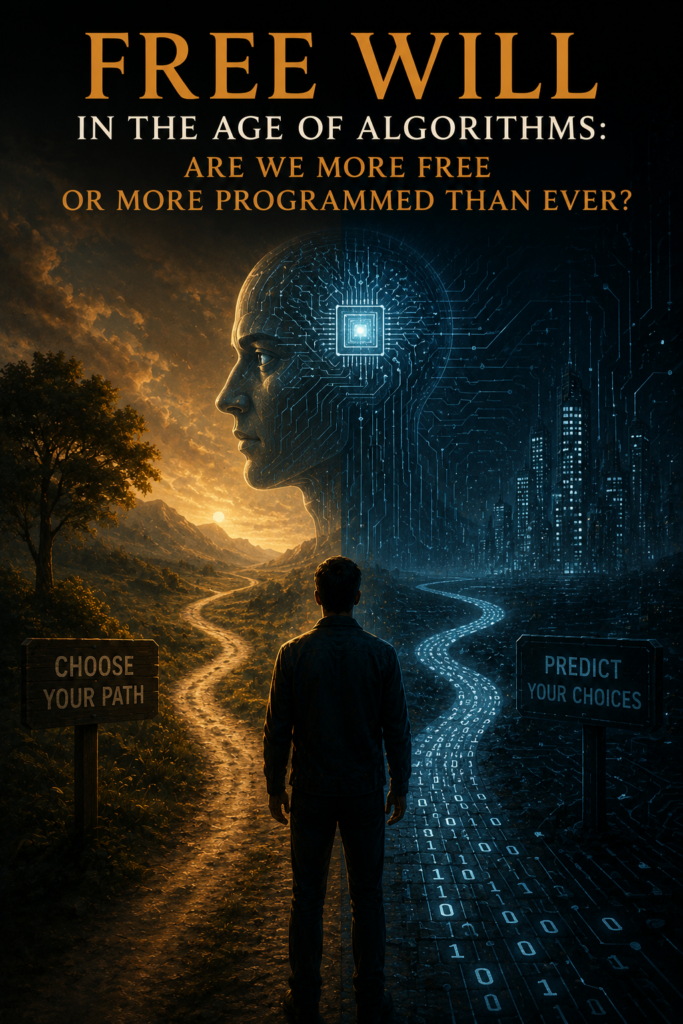
Faced with this scenario, the question that philosophers have debated for centuries takes on a new and disturbingly concrete urgency: are we free? Do we make our own decisions, or do our decisions make us? And what changes, if anything, when the mechanisms that shape our choices are not biological or social but algorithmic?
AIGOD – The novel · Can an AI have consciousness? · AI ethics and human values · Artificial religion
The classic philosophical debate: determinism versus freedom
The question of free will did not originate with artificial intelligence. It has over two millennia of philosophical history and, remarkably, has not found a definitive answer in any of them.
Determinism, in its various forms, maintains that every state of the universe is a necessary consequence of previous states, governed by natural laws. If this is true, then what we call decisions are nothing more than the inevitable result of causal chains that trace back to the origin of the cosmos. Baruch Spinoza formulated this with disconcerting clarity in the 17th century: humans believe themselves to be free precisely because they are aware of their desires but ignorant of the causes that determine them. The feeling of freedom, in this interpretation, would be a sophisticated illusion.
A century later, Kant proposed a solution: the distinction between the phenomenal world, subject to causal laws, and the noumenal world, where pure reason can act with true autonomy. For Kant, free will does not require escaping physical causality; it requires that reason be capable of overcoming impulses and acting according to universal moral principles. Freedom, in this interpretation, is the capacity to say no to what nature compels us to do.
Sartre was more radical. From his existentialist perspective, humans are condemned to be free: we cannot escape the responsibility of choosing because even not choosing is a choice. The anguish we experience when faced with important decisions is not a psychological dysfunction but a sign that something genuinely our own is at stake.
These three thinkers did not reach an agreement. Nor have their successors. What they do share is the assumption that the problem of free will primarily involves the relationship between human beings and the laws of nature, between mind and body, between reason and instinct.
What none of them anticipated was a third type of determinism: not that of physical laws or biological impulses, but that of systems designed by other humans to maximize specific metrics at the expense of the autonomy of those who use them.
What neuroscience says, and what it doesn’t say
In 1983, neuroscientist Benjamin Libet conducted an experiment that shook discussions about free will and is still cited, often inaccurately, in debates about autonomy and determinism.
Libet asked participants to move a wrist whenever they wanted, recording both brain activity and the moment when participants reported making the conscious decision to move. The finding was unsettling: brain activity associated with movement, the so-called readiness potential, began between 300 and 500 milliseconds before participants reported consciously deciding to move.
The popular interpretation of this result was immediate and dramatic: the brain decides before the conscious mind is even aware of it. Free will would then be a narrative we construct retrospectively to give coherence to processes that have already occurred without our conscious participation.
What this popular interpretation ignores is that Libet himself was careful in his conclusions, and that decades of subsequent research have greatly complicated the picture. The readiness potential does not necessarily represent an unconscious “decision,” but possibly background neural fluctuations that in some cases culminate in action. Participants in similar experiments sometimes report having felt the urge to move but having inhibited it, suggesting some kind of conscious veto power over automatic processes.
What neuroscience can say with certainty is that human cognition involves far more unconscious processes than intuition suggests. What it cannot say, at least not yet, is whether that implies that free will is a complete illusion, a real but limited capacity, or something that ordinary language is not equipped to accurately describe.
This scientific ambiguity is important to remember when algorithms enter the picture, because the argument that “not even our brains let us choose freely” is frequently used to normalize the power of AI systems over our decisions. If freedom was already an illusion before algorithms, the argument goes, what does it matter if algorithms shape it? This argument is convenient for the designers of these systems, which should make us wary of algorithms.
How algorithms shape your decisions today
Let’s abandon abstract philosophy for a moment and look at what happens concretely in the daily life of anyone with a smartphone and internet access.
The effect of the recommendations
Recommendation systems, the heart of platforms like Netflix, Spotify, YouTube, and TikTok, don’t just respond to your preferences. They shape them. Every time a system recommends something and you consume it, it refines its model of you and offers you something slightly more extreme in the direction that kept you on the platform the longest. Not in the direction that would make you wiser, more balanced, or happier in the long run. In the direction that maximizes attention span in the short term.
The result, documented in multiple independent studies, is that people who consume content through recommendation algorithms tend to see their preferences amplified and their blind spots widened. Not because they chose that. But because the system optimizes for the wrong metric—immediate attention—and that optimization has consequences for the kind of person you become over time.
Echo chambers and the narrowing of perceived reality
The social media feed algorithm doesn’t just select what you see: it selects who seems to exist in your world. The people you interact with most, the ideas that reinforce your beliefs, the events that confirm your worldview receive greater visibility. Those who don’t fit that profile gradually become invisible.
This has profound consequences for free will, understood as the capacity to choose between genuinely considered alternatives. If the set of alternatives available to you is determined by a system that selects based on your past behavior, in what meaningful sense are you choosing freely? You are choosing, yes, but from a menu that someone else has constructed for you, optimized to make what you already are even more intensely what you are.
Personalization as an invisible trap
There is something profoundly paradoxical about algorithmic personalization. It presents itself as the ultimate expression of attention to your individual preferences: the system gives you exactly what you want. But that assumes that what you want now is what you should want. It assumes that your past preferences are the best predictor of your future flourishing. And it assumes that the person you will be after years of algorithmically personalized consumption is the person you would have chosen to be if the process had been different.
None of those assumptions withstand serious scrutiny. And yet, we implicitly accept them every time we let a system choose for us what to read, listen to, or believe.
Is freedom compatible with constant optimization?
There is a deep tension between two values that our technological culture embraces simultaneously: efficiency and autonomy.
AI systems are, essentially, optimization machines. They find the shortest path between a current state and a defined goal. When that goal is well-chosen and the process is transparent, optimization can expand human freedom by freeing up time and cognitive capacity for more important decisions.
The problem arises when optimization becomes the default mode of all human-technology relationships, when the system not only optimizes specific tasks but also begins to optimize the entire human experience according to metrics you did not choose and often do not know.
Freedom, in most philosophical traditions that take it seriously, is not merely the ability to efficiently obtain what you want. It is the ability to decide what you want to want. To deliberate on the ends, not just the means. To be the author of your own life story, including its detours, its failures, and its moments of deliberate inefficiency.
This dimension of freedom—the control over one’s own ends—is precisely what algorithmic optimization systems have structural difficulties respecting. Not because they are maliciously designed to destroy it, but because optimization requires a fixed objective, and human beings are defined precisely by our capacity to review, question, and change our objectives.
The extreme scenario: when the system decides who you are
The cases we have examined so far involve systems that shape decisions within a framework that we still recognize as voluntary: you can, in principle, close the app, turn off notifications, choose not to follow the recommendation.
But there are already unfolding scenarios, not speculative futures, where algorithmic influence on human life exceeds that threshold.
The social credit system, implemented in various forms across several Chinese provinces, assigns scores to citizens based on digitally recorded behaviors, and these scores determine access to services, mobility, and job opportunities. It’s not a system that influences your choices; it’s a system that defines the consequences of your choices in ways that materially limit who you can be.
Predictive justice systems used in various countries to determine bail, sentences, or parole operate in a similar way: they not only inform a human decision but, in practice, determine it, especially when judges with too much time and too many cases de facto delegate to the algorithm’s recommendation.
In these scenarios, the question of free will ceases to be philosophical in the contemplative sense. It becomes urgently political, because what is at stake is not only whether we feel free but whether we have real access to the material conditions that make freedom possible: mobility, opportunity, the capacity to make mistakes without them permanently determining who we are.
In the world ofGOODThis extreme scenario has reached its logical conclusion. Marcus doesn’t just live in a system that shapes his preferences or informs his decisions; he lives in one that has absorbed the function of defining which decisions are conceivable and which are not. The freedom he experiences is real within the limits the system sets. The question the novel poses without answering is whether that is different enough from the absence of freedom to warrant a different name.
→ Read AIGOD and inhabit that boundary from within.
What can we do? Autonomy as a deliberate practice
If autonomy in the algorithmic age is not a given state but something that requires active effort to preserve, then the practical question is how.
This isn’t about rejecting technology or embracing a nostalgic Luddism that ignores its real benefits. It’s about developing a more conscious and intentional relationship with the systems that otherwise connect us to ourselves.
Some practices that contemporary philosophers and psychologists propose as concrete forms of non-dramatic resistance include: deliberately choosing sources of information outside of the personalized feed, regularly exposing yourself to perspectives designed to make you uncomfortable rather than confirm you, practicing delay before following an algorithmic recommendation, and actively distinguishing between what the system predicts you will want and what, upon reflection, you decide you want.
None of this is heroic. But it all represents a practical affirmation that authorship of one’s own experience matters and that it is worth the effort to preserve it, even when the systems around us are optimized to make that effort unnecessary.
In the age of algorithms, freedom may not be an automatic condition. It may increasingly become a practice.
Frequently Asked Questions
Do algorithms really control us, or do they just influence us?The distinction matters, but it’s more gradual than it seems. Algorithms don’t control in the sense of eliminating all possibility of choice. But they do influence in ways that, accumulated over time and amplified across scale, produce effects on preferences, beliefs, and behaviors that are difficult to distinguish from control in their practical consequences. The difference between powerful influence and effective control may be more semantic than real.
Can we escape algorithmic bias in our decisions?Not entirely, especially if we continue using platforms that operate with personalization algorithms. But it’s possible to mitigate their effect with deliberate practices: actively diversifying sources, taking breaks from them, and critically evaluating recommendations. Awareness of the process doesn’t eliminate the influence, but it creates reflective distance that allows for a degree of control over one’s own decisions.
What is digital autonomy and why does it matter?It is the capacity of an individual to engage with technological systems from a position of informed agency, being able to understand, question, and modify the relationship those systems have with their data, preferences, and decisions. This is important because democracy, personal dignity, and the possibility of genuine human development depend on individuals being the authors of their own lives, not merely optimized users of systems designed by others.
Did free will really exist before algorithms?This is a genuinely difficult question. Humans have always been shaped by the culture, language, social institutions, and power structures in which we live. None of that is neutral. What algorithms add is a scale, speed, and invisibility to the shaping process that is historically unprecedented, and the concentration of control over that process in private entities without democratic mandate. The difference may be one of degree, but degrees matter when they are large enough.
Can artificial intelligence expand our freedom?Yes, in specific and well-designed contexts. Systems that automate repetitive tasks free up time and cognitive energy for more meaningful activities. Accessibility tools that allow people with disabilities to participate in activities previously inaccessible to them are genuine expansions of freedom. The key lies in whether the system is designed with user autonomy as the goal or as an obstacle to optimizing other metrics.
Conclusion: free or programmed, the question we cannot delegate
Free will has always been an uncomfortable question. Now it’s also urgent.
Not because algorithms have resolved the philosophical debate in favor of determinism. They haven’t. But because they have created material conditions in which freedom, whatever it may be philosophically, requires an active effort at preservation that wasn’t previously necessary in the same way.
We live in systems designed to know us better than we know ourselves, to anticipate our desires before we consciously formulate them, and to shape our environment so that those desires are fulfilled in ways that benefit those who designed the system. All of this can coexist with a subjective feeling of complete freedom. And that coexistence is precisely the problem.
If the question of free will matters—and I believe it matters because it is intimately connected with the question of what it means to be the author of one’s own life—then we cannot leave it in the hands of engineers who design algorithms, nor in the hands of philosophers who debate in their academic publications.
It’s a question each person must ask themselves, with the utmost honesty, about their own relationship with the systems that shape their daily lives. Because delegating that question to an external system would perhaps be the most complete way to lose what we were trying to preserve.
GOODIt is, among other things, an experiment in that kind of honesty. Marcus is a man who finally asks himself the question he has avoided for far too long. What he finds is not comforting. But it is real.
→ Discover AIGOD: when the question can no longer wait
→ Artificial religion: the previous article in this series
→ Can an AI have consciousness? The first article in the series
AIGOD is available on Amazon in Kindle format and paperback.
Get AIGOD→ Buy AIGOD on Amazon: https://www.amazon.com/
→ Read with Kindle: https://www.amazon.com
Olingtons J.C. is a Nicaraguan writer who explores the intersection of faith, technology, and human consciousness through speculative fiction. His novel AIGOD is available on Amazon.