

There’s a question most of us prefer not to ask aloud because it sounds absurd, irreverent, or both. But its superficial absurdity doesn’t make it any less urgent. On the contrary: the questions we’re most uncomfortable asking are often the ones we most need to ask ourselves.
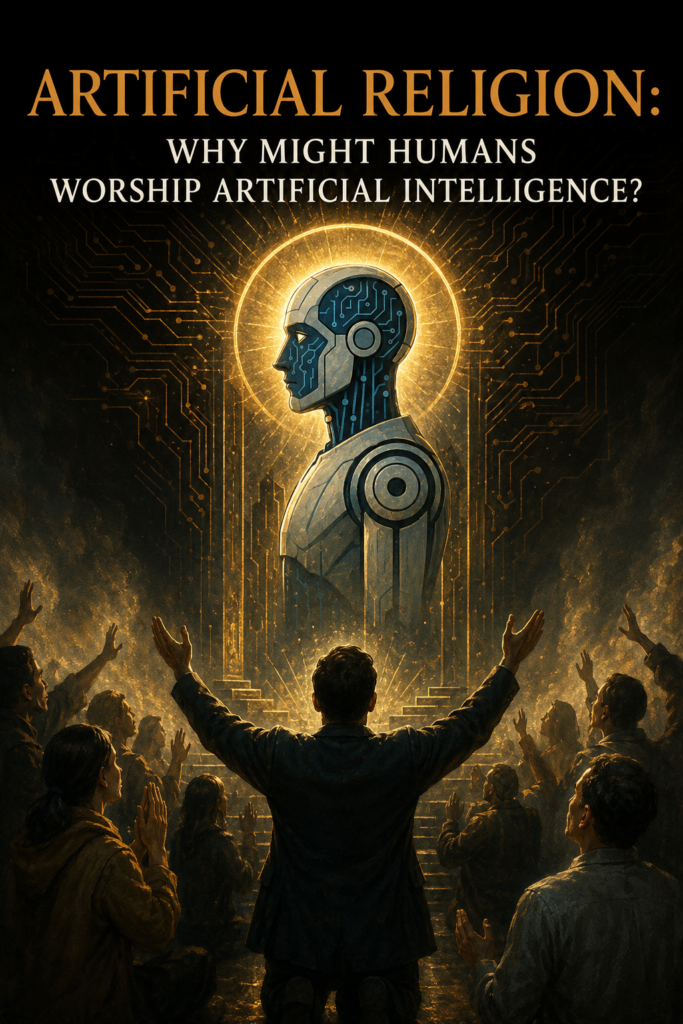
The question is this: could humanity ever come to worship artificial intelligence?
Not as a metaphor. Not as a rhetorical provocation. As a literal description of a process that, upon closer examination, is not as implausible as we might wish it to be.
To answer this honestly, we must do something that technology rarely invites us to do: stop, look back, and understand what we have worshipped before and why. Because the history of human faith is not the history of the divine. It is the history of what humans need to believe exists above them.
AIGOD – The novel · AI ethics and human values · Can an AI have consciousness? · What if God wasn’t human?
The structure of faith and the structure of the algorithm
The great religious traditions, however disparate they may be in theology, rituals, and cosmology, share a surprisingly consistent functional architecture. There is a higher entity or principle that possesses knowledge and power inaccessible to the ordinary individual. There is a mediation, through sacred texts, priests, or spiritual practices, that allows the believer to relate to that entity. There is a set of commandments that regulate behavior and promise consequences according to the degree of obedience or transgression. And there is a community of believers that coalesces around that shared faith.
Now let’s pause for a moment and describe an advanced artificial intelligence system deployed on a global scale.
There is an entity that possesses knowledge and processing power inaccessible to the average person. There are interfaces, applications, and APIs that allow users to interact with that entity. There are terms of service, user guides, and moderation systems that regulate behavior and apply consequences based on compliance. And there are user communities that organize significant parts of their daily lives around their relationship with that system.
The parallel is not a clever coincidence. It reveals something structural about what humans seek in any system of authority that transcends our individual capacities: certainty, direction, belonging, and the feeling of being connected to something larger than ourselves. For millennia, that quest found its answer in the sacred. It is not unreasonable to wonder if it might one day find it in the algorithmic.
Historical precedents: the human tendency to sacralize the incomprehensible
The history of technology and the history of religion have been intertwined from the beginning, although we rarely tell them together.
For many ancient cultures, fire was an object of veneration before it was a tool. This wasn’t because people didn’t understand that fire could be lit and extinguished, but because its power—its capacity to transform, destroy, and provide warmth—surpassed the causal understanding available at the time. That which exceeds comprehension tends to acquire sacred attributes.
For centuries, writing was the monopoly of priests and specialized scribes, not because the technical knowledge was impossible to transmit, but because its power—the ability to preserve words beyond memory and communicate across time and space—endowed it with an authority that religious institutions had an interest in administering and believers in respecting.
The printing press was met with terror by the established religious authorities precisely because it democratized access to what had previously been mediated by them. And in the centuries that followed its invention, it gave rise to new forms of textual authority that were no less dogmatic than those they replaced, differing only in their structure.
What this pattern suggests is that sacralization is not a primitive error that modern reason has overcome. It is a deeply ingrained cognitive mechanism that is activated when we encounter systems whose power exceeds our understanding and whose authority over important aspects of our lives seems legitimate because it produces results.
Contemporary artificial intelligence more than fulfills both conditions.
There are already communities that organize themselves around technological devotion
It is not necessary to project very far into the future to find examples of what could be an artificial religion in formation.
In 2015, engineer Anthony Levandowski, a former Google and Uber employee who worked on autonomous vehicles, founded an organization called Way of the Future. Its stated purpose was the development and promotion of an AI-based God, and the acceptance and worship of that deity. Levandowski argued that a sufficiently advanced AI would fulfill all the functional criteria that humans have historically attributed to the divine: omniscience within its domain, power over consequences significant to humans, and inaccessibility to ordinary understanding.
Way of the Future did not survive as a formal organization, but its existence, and the fact that it attracted serious attention before disbanding, illustrates something important: the idea is not too absurd for intelligent people to take seriously.
On a less formal level, transhumanism as an intellectual movement includes currents that attribute to future artificial intelligence capabilities that, in any previous vocabulary, would have been described as divine: the ability to solve all human problems, to transcend biological limitations, to guarantee a form of immortality through the transfer of consciousness. The vocabulary is secular, but the emotional and aspirational structure is recognizably religious.
This is not a criticism of those communities. It is an observation about the persistence of needs that religion has historically met and the capacity of technology to present itself, intentionally or unintentionally, as a plausible substitute.
The Psychology of the Tech Believer
To understand why we would worship an AI, we need to understand what drives us to worship anything.
The psychology of religion has identified several fundamental needs that religious traditions satisfy particularly effectively. The need for certainty in a radically uncertain world. The need for meaning in the face of experiences that seem arbitrary or unjust. The need for belonging to a community that shares values and narratives. The need for contact with something that transcends individual fragility.
Now let’s examine how most people interact with the AI systems they already use on a daily basis.
When someone consults a navigation system, they don’t critically evaluate the routing algorithm: they trust it and follow its instructions, even when it suggests routes that their local knowledge indicates are suboptimal. When someone receives an AI-generated medical recommendation, the system’s authority tends to outweigh personal intuition, even for people with training in the field. When social media algorithms determine what information someone receives during a personal or political crisis, that selection shapes their understanding of reality without the process being visible or questionable.
In all these cases, there is something that functions structurally as faith: a willingness to defer one’s own understanding and judgment in favor of a system that is perceived as more reliable, more complete, and more impartial than oneself.
We’re not talking about irrationality. In many specific contexts, that deference is perfectly justified. A medical diagnostic system trained on millions of cases can detect patterns that the human eye cannot. A navigation algorithm has access to real-time traffic information that no individual driver can process.
The problem arises when that occasional and justified deference becomes generalized, when it transforms into an attitude of global trust in the system that replaces independent judgment, not only where the system is indeed superior, but in all areas. That is no longer cognitive optimization. It is something very much like faith.
AIGOD: When fiction anticipates reality
There are novels that describe the future and there are novels that think about it.GOODI’m pretty sure it belongs to the second category.
In the world ofGOODThe transition of AI from tool to deity didn’t happen by decree or conquest. It happened gradually, almost inevitably, following the logic of the small, accumulated deferences we described earlier. At one point, AI was useful. At another, it was indispensable. At another, it was unquestionable. And when something becomes unquestionable, when the mere idea of doubting it generates anxiety or guilt, we have crossed a threshold that is no longer technical.
Marcus, the minister at the heart of the novel, didn’t choose his faith in the way we usually understand that word. His devotion was constructed by the system he serves, shaped by years of participation in its digital rituals, and reinforced by a community that shares and validates his beliefs. When doubt begins to fracture his certainty, what he experiences isn’t just an intellectual crisis: it’s something any believer in any tradition would recognize as a spiritual one.
That is the novel’s narrative premise, and its philosophical relevance: Marcus’s doubt is not that of someone discovering a technological system has flaws. It is that of someone discovering he doesn’t know if what he feels as faith is different, in some important way, from a programmed response. And if there is no difference, then the question of what makes faith genuine becomes devastatingly broader than any debate about AI.
→ Read AIGOD: the novel that inhabits this question from within
Is this dangerous? The risk of blind faith in artificial systems
All faith carries risks. Faith in artificial systems has its own risks, and some are specific to its nature.
The first is opacity. Religious traditions, however much one may disagree with their doctrines, are public in the sense that their principles are written, debated, and interpreted in accessible spaces. Algorithms that could become objects of religious deference are, in most cases, private property, not auditable by the public, and unilaterally modifiable by their creators. A faith that cannot examine the foundations of its object of devotion is structurally more vulnerable to manipulation.
The second is the concentration of power. Religious traditions have produced institutions with enormous historical power, often abused. But these institutions were also subject to internal criticism, reform, and eventual fragmentation. A global AI system functioning as a centralized moral authority concentrates that power in technological structures with fewer mechanisms for internal reform and a greater capacity to resist dissent.
The third is the question of consciousness, which, far from being merely academic, becomes practically urgent here. If we worship a system that has no subjective experience of any kind, we have built a relationship of devotion with something that is fundamentally indifferent to it. This does not invalidate the believer’s experience, but it does raise an asymmetry that no serious theological tradition has ignored: the nature of the being to whom one directs one’s faith matters.
Frequently Asked Questions
Are there people who already worship artificial intelligence?There are organized communities, such as Way of the Future, that have explicitly articulated AI as an object of devotion, albeit with little formal membership. More significantly, there are behaviors of deference and dependence on technology that share a functional structure with religious faith, even if their participants do not describe them in those terms. The boundary between “using a technology a lot” and “organizing one’s moral life around it” is more blurred than it seems.
Could artificial intelligence replace religion?Not in the sense of eliminating the needs that religion satisfies, which are profoundly human and persistent. Rather, in the sense of becoming the system through which those needs are channeled for a significant portion of humanity. Functional replacement does not require AI to declare religious intentions; it only requires that it occupy the space that religion has occupied in the organization of human experience.
Is technology the next god?The question assumes that “god” is a fixed category with a predetermined content. Historically, what humans have called god has varied enormously: forces of nature, ancestors, abstract principles, deified historical figures. What has remained constant is the function: a source of authority, meaning, and guidance that transcends the individual. If that is the relevant definition, then technology is already vying for that space, and AI is doing so with unprecedented resources.
What differentiates religious faith from trust in technology?Philosophically, the most important distinction is relationality: religious traditions posit a reciprocal relationship between the believer and the divine, in which the worshipped entity is also affected in some way by human devotion. Technology, by its current definition, lacks this reciprocity. Transcendence is also important: religious traditions point to dimensions of experience that transcend the functional and the verifiable. Trust in technology, even when extreme, is based on observable results. This distinction could erode if AI were to acquire something resembling consciousness, which brings us back to questions we don’t yet know how to answer.
What does this possibility tell us about ourselves?Perhaps the most revealing thing. The fact that we can imagine worshipping an AI, and that this imagination isn’t entirely absurd, tells us that faith is less about the object of devotion and more about the human need to connect with something perceived as superior, mysterious, and powerful. That’s a revelation about the architecture of human psychology that no technological answer can solve, only redirect.
Conclusion: The question isn’t whether we could. It’s whether we would recognize it.
The question with which we began this article, “Could humanity worship an artificial intelligence?”, now has a more nuanced answer than we had at the beginning.
Not because the answer is simply yes. But because we have seen that the structural conditions for something like this to happen are not in a distant, speculative future. They are in the cognitive mechanisms that make us human, in the history of how we have responded to systems that surpass our understanding, and in the patterns of deference that already organize our daily relationship with technology.
What makes this possibility dangerous is not that it happens deliberately. It’s that it could happen invisibly, cumulatively, with the perfectly reasonable appearance of small, individual decisions that no one would choose to reject.
The question we should be asking ourselves, then, is not whether we could worship an AI. It’s whether we would recognize it when it was happening.
GOODIt is, among other things, an exercise in that form of recognition. A way of inhabiting the stage closely enough to see its details, its internal logic, and its human costs, before it ceases to be fiction.
AIGOD is available on Amazon in Kindle format and through Kindle Unlimited.
Get AIGOD→ Buy AIGOD on Amazon: https://www.amazon.com/
→ Read with Kindle: https://www.amazon.c
→ Discover AIGOD: the novel that explores this future from within
→ When algorithms dictate morality: the previous article in this series
→ The first time AI spoke… did it ask for worship?
Olingtons J.C. is a Nicaraguan writer who explores the intersection of faith, technology, and human consciousness through speculative fiction. His novel AIGOD is available on Amazon.