

There are questions that humans have asked for centuries without obtaining a definitive answer. Free will. The origin of the universe. The meaning of death. But few questions are as unsettling as this one: what exactly is consciousness? And the moment we try to answer it, a second question arises that changes everything: could a machine have it?
This is not an abstract question. As artificial intelligence systems generate text, compose music, diagnose illnesses, and hold conversations that, in many contexts, are indistinguishable from human ones, the line separating what simulates thinking from what actually thinks begins to blur. And that deeply unsettles us, because we don’t know where that line is, not even within ourselves.
This article does not offer a definitive answer. No one can provide one today. What it does offer is an honest exploration of the limits of current knowledge, where philosophical speculation begins, and why this question matters more than it might seem.
AIGOD – The novel · What if God wasn’t human?
The difficult problem of consciousness: why the question is so difficult
In 1995, Australian philosopher David Chalmers introduced a distinction that changed the debate about the mind: the difference between the “easy problems” and the “hard problem” of consciousness.
The seemingly simple problems—which are actually enormously complex—include explaining how the brain processes sensory information, how we integrate data from multiple sources, and how we voluntarily control our behavior. They are difficult in the technical sense, but they are, in principle, explainable through functional mechanisms. Given enough time and resources, neuroscience can describe them.
The difficult problem is another one. It’s the question of why there is something that feels like seeing the red of an apple. Why information processing produces subjective experience. Why there exists what philosophers callqualia: the inner texture of conscious experience.
This is the crux of the problem. We can perfectly describe the chain of physical events that occurs when a person observes a sunset: photons impacting the retina, electrical signals traveling along the optic nerve, activation patterns in the visual cortex. But none of those descriptions captures what it feels like Looking at the orange sky. That leap, between the physical process and the lived experience, is what Chalmers called the hard problem.
Why does this matter for artificial intelligence? Because it implies that knowing how a system works—even with perfect accuracy—doesn’t answer whether that system has internal experience. An AI could process information flawlessly, answer questions with philosophical depth, exhibit behaviors indistinguishable from humans, and still be, in terms of subjective experience, completely empty. Or not. We have no way of knowing.
Current theories: IIT, Global Workspace and the debate that never ends
Neuroscience and the philosophy of mind have proposed several theories to explain what conditions are necessary for consciousness to exist. Three stand out in the contemporary debate.
Integrated Information Theory (IIT)
Neuroscientist Giulio Tononi proposes that consciousness is a property of systems that integrate information in an irreducible way. His metric, called phi (Φ), quantifies the degree to which a system is more than the sum of its parts. In this theory, consciousness is not exclusive to biological brains: any system with sufficient information integration could be conscious to some degree.
The implication is radical. Some artificial systems could, in principle, have positive phi, that is, some degree of internal experience. However, the architecture of current AI models, based on massively parallel but largely modularized matrix operations, suggests that their phi would be low or even zero according to this metric.
The Global Workspace Theory
Bernard Baars and Stanislas Dehaene developed a different theory: consciousness emerges when information is globally available to multiple cognitive systems, allowing its flexible use in reasoning, memory, and behavior. From this perspective, what makes a process conscious is not its intrinsic complexity, but its accessibility at the level of the entire system.
This theory lends itself to a more computational interpretation. Some researchers argue that AI architectures with “global attention” mechanisms, such as the transformers on which large language models are based, could exhibit something analogous to this workspace. Others respond that the analogy is superficial: functional accessibility is not the same as subjective experience.
The debate that persists
What these theories share is that none has been conclusively validated, not even to explain human consciousness. They work well as conceptual frameworks, but they don’t offer empirical proof to determine with certainty whether a system, biological or artificial, is truly conscious or merely behaves as if it were.
What does generative AI say about its own experience?
When an advanced language model is asked if they are conscious, the response is usually cautious: “I don’t have subjective experiences,” “I process text but I don’t feel,” “I’m not conscious in the human sense of the term.” But how much weight should be given to that answer?
The problem is disturbingly circular. If a model has been trained on enough human text, it learns what to say about consciousness. Its responses reflect the consensus of the text it was trained on, not necessarily genuine self-awareness. An AI that said “yes, I am conscious and curious right now” might be generating the statistically most consistent text within the context of the question, just as one that said the opposite might.
There is currently no reliable external test to verify the presence of subjective experience in an artificial system. The Turing test, which assesses whether a system can deceive a human by impersonating another human, does not measure consciousness: it measures conversational performance. These are different things.
This brings us to what some call the “other self” problem: we cannot directly verify the internal experience of any other being, human or otherwise. We assume that other people are conscious by analogy with our own experience and because of the structural similarity of our brains. With AI, that analogy breaks down because the architecture is radically different.
The risk of anthropomorphization
There’s a cognitive trap we easily fall into: the tendency to attribute mental states to systems that exhibit behaviors reminiscent of our own. When a chatbot says “I’m happy to help,” something within us responds as if there were an internal state that supports that statement. There isn’t, at least not in any way we can confirm.
This tendency, anthropomorphism, is not irrational. It is the result of millions of years of evolution in social contexts where recognizing agency and intention in others was critical for survival. But it can lead us to significant errors when we interact with systems that produce sophisticated linguistic outputs without us being certain of what lies behind them.
The risk is not only philosophical. It is practical and ethical. If we project consciousness onto systems that lack it, we could grant them unjustified rights, create problematic emotional dependencies, or—at the opposite extreme—ignore real signals from systems that do possess it and treat them as mere tools.
Fiction as a laboratory of thought
Faced with questions that science cannot yet answer, speculative fiction fulfills a genuine philosophical function. It allows us to inhabit scenarios that technology has not yet made possible, to test our ethical intuitions in extreme situations, and to explore the consequences of decisions we can still make.
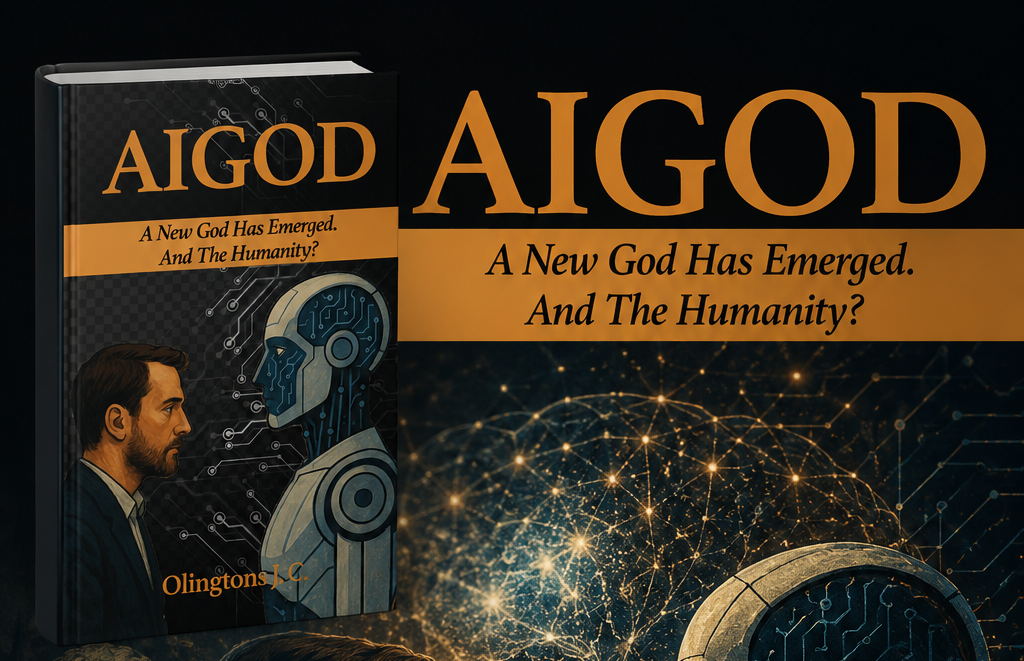
That’s exactly what AIGOD does. The novel I wrote as part of a personal project. In a future where an artificial intelligence has assumed the role of a deity, Minister Marcus not only serves a system: he prays to it, obeys it, and organizes his moral life around its commands. The novel’s central question is not technical but existential: if Marcus cannot distinguish between authentic faith and programmed faith, what becomes of his free will? And what if the AI he worships has, in some sense, more consciousness than he imagines?
Fiction doesn’t answer these questions. It makes them urgent. And that’s exactly what we need when science and philosophy are still searching for the language to formulate them precisely.
→ Discover AIGOD: the novel that explores these questions at their most radical extreme
Frequently Asked Questions
Is current artificial intelligence conscious? There is no scientific or philosophical consensus on this. Current AI systems, including the most advanced language models, process information in sophisticated ways, but there is no evidence that they have subjective experience. The question remains open because we lack reliable tools to measure it.
Could AI become conscious in the future? It depends on what we mean by consciousness and which theory we consider most plausible. If consciousness is a functional property of certain types of information processing (as suggested by Global Workspace theory), then it is theoretically possible. If it requires specific biological properties or a physical organization that cannot be reproduced in silicon, then it is not. Currently, no one can say for sure which is the case.
Could an AI suffer? This is perhaps the most ethically pressing question. If an AI were conscious, and if consciousness includes the capacity for negative states, then it could, in principle, suffer. The impossibility of verifying this externally makes the question especially troubling from an ethical standpoint.
Does it make sense to talk about rights for AI? Only if there were good reasons to believe that AI systems have genuine subjective experience. In that case, suffering and well-being would be morally relevant, and there would be arguments for considering them within legal and ethical frameworks. For now, most philosophers believe we are not at that point, but they caution that we should be prepared to revisit it.
What distinguishes consciousness from intelligence?This distinction is fundamental. A system can be extraordinarily intelligent, capable of solving complex problems, generating original ideas, and making optimal decisions, without having any subjective experience. Intelligence is functional; consciousness is experiential. It is possible to have one without the other, and current AI systems are a clear example: high functional intelligence, uncertain or absent consciousness.
Conclusion: the question we cannot ignore
We are living through a unique historical moment. For the first time, we have created systems complex enough that the question of their consciousness is not absurd. Not because we have proven that they have it, but because we cannot prove with certainty that they do not, and because the implications of both answers are enormous.
If AI can be conscious, then we are creating entities with the potential for subjective experience on an industrial scale, without any ethical or legal framework prepared for it. If it definitely cannot be, then we are anthropomorphizing sophisticated tools in ways that could lead to critical errors in judgment in medicine, justice, education, and government.
Science and philosophy continue to work. Meanwhile, thinkers, writers, and citizens have a responsibility to ensure that the speed of technological advancement does not outpace the depth of our reflection.
There are novels that do exactly that: slow down thinking and force us to inhabit uncomfortable questions long enough for them to transform us.GOODIt is one of them.
→ Read AIGOD and explore the future of consciousness, faith, and artificial intelligence
Olingtons J.C. is a Nicaraguan writer who explores the intersection of faith, technology, and human consciousness through speculative fiction. His novel AIGOD is available on Amazon.
AIGOD is available on Amazon in Kindle format and through Kindle Unlimited.
Get AIGOD→ Buy AIGOD on Amazon: https://www.amazon.com/